Disclaimer: SamCart and SamCart Support are not tax advisors. The information in this article is intended for general awareness only and does not constitute tax advice. For guidance specific to your business or situation, we strongly recommend consulting a qualified tax professional or CPA.
1. US Sales Tax — The Basics
What Is Sales Tax?
- A consumption tax collected at the point of sale by the seller, then remitted to the state/local government.
- Rates vary by state, county, and city — there is no single national sales tax rate.
- Not all products are taxable everywhere. Physical goods, digital goods, SaaS, and services each have different taxability rules depending on the state.
Who Has to Collect?
You must collect sales tax in a state if you have nexus there (see Section 2).
What About Digital Products & SaaS?
- Rules vary widely. Not all states tax digital goods or SaaS.
- Some states tax downloaded software but not SaaS. Some tax both. Some tax neither.
- This is one of the most common areas of confusion — customers should verify their specific product type’s taxability state by state.
2. Nexus — The Trigger for Tax Obligations
What Is Nexus?
Nexus is the connection between a business and a state that creates a tax obligation. If you have nexus in a state, you are required to collect and remit sales tax there.
Two Types of Nexus
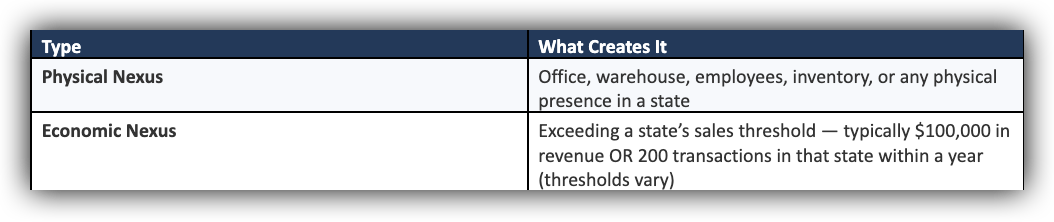
Key Points to Know about Taxes
- Wayfair: Economic nexus exists because of the 2018 South Dakota v. Wayfair Supreme Court decision — it applies to online/remote sellers even with zero physical presence.
- 45+ states: Every state with a sales tax (45 states + DC) has economic nexus laws.
- 5 states with NO sales tax: Alaska, Delaware, Montana, New Hampshire, Oregon.
- Alaska has no state sales tax but some local jurisdictions do collect.
- Nexus is evaluated per state — a seller may have nexus in 3 states or 30.
- Once a threshold is crossed, the obligation typically begins on the next transaction or within 30–60 days.
3. Registration, Collection & Filing
The Required Sequence
- Determine where you have nexus
- Register for a sales tax permit in each nexus state
- Configure tax collection (rates, product taxability)
- Collect tax from customers at checkout
- File returns and remit collected tax on schedule
Registration
- Before collecting tax: you must register for a sales tax permit
- Collecting without a permit is illegal in most states.
- Registration is done through each state’s Department of Revenue (or equivalent).
- Shortcut: Streamlined Sales Tax (SST) program allows registration in ~24 states through a single application at sstregister.org.
- For other states, registration must be done individually.
Filing Frequency
- States assign a filing frequency based on your sales volume: monthly, quarterly, or annually.
- Due dates vary by state (commonly the 20th of the month following the period).
- Early filer perk: Some states offer small discounts for timely filing.
- Important: You must file even in periods with zero sales — failing to file a $0 return can trigger penalties.
4. The Danger Zone: Collecting Tax & NOT Remitting
⚠ The MOST IMPORTANT information ⚠
Why This Matters
- Trust fund money: Sales tax collected from customers is trust fund tax — it belongs to the government, not the business.
- If a business collects sales tax and does not file/remit, this is considered misappropriation of government funds.
- Consequences can include:
- Back taxes owed with interest
- Penalties (often 25–50% of unpaid tax)
- Personal liability for business owners/officers (pierces the corporate veil)
- In extreme cases, criminal charges
Common Scenario
A customer starts collecting tax through their platform but never registers with the state or files returns. The money sits in their account. This creates a growing liability that gets worse every month.
5. International Tax — VAT, GST & Digital Services Taxes
VAT (Value Added Tax)
- VAT is the international equivalent of sales tax, used in 170+ countries (EU, UK, Canada, Australia, and more).
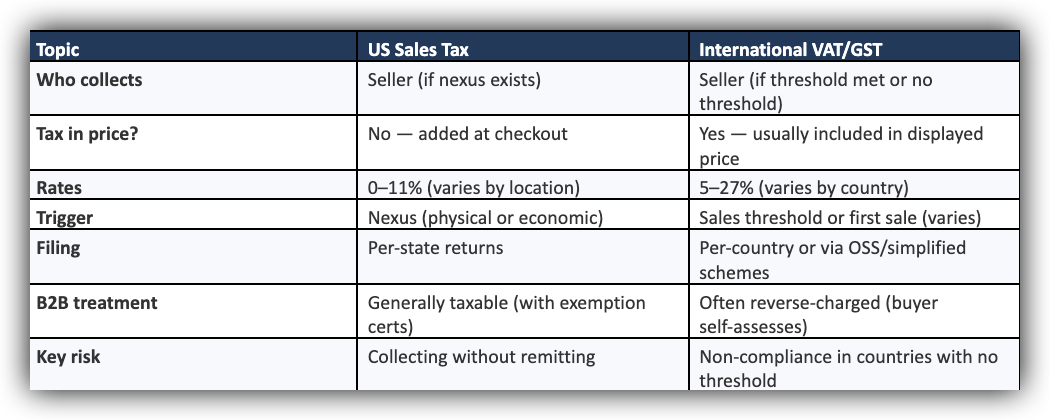
- Key difference: Unlike US sales tax, VAT is typically included in the displayed price (not added at checkout).
- VAT rates are generally higher than US sales tax — common ranges are 15–27%.
Digital Services & VAT
- Most countries now require non-resident digital sellers to collect and remit VAT on B2C sales.
- Example: A US-based seller of digital products selling to a customer in Germany must collect German VAT (19%).
- EU: Since July 2021, all digital sales to EU consumers are subject to VAT regardless of volume.
- UK: VAT registration required when selling digital services to UK consumers (standard rate 20%).
- Canada: GST/HST applies to digital products; thresholds vary by province.
- Australia: GST (10%) applies for sellers exceeding AUD $75,000.
VAT Registration & Compliance Thresholds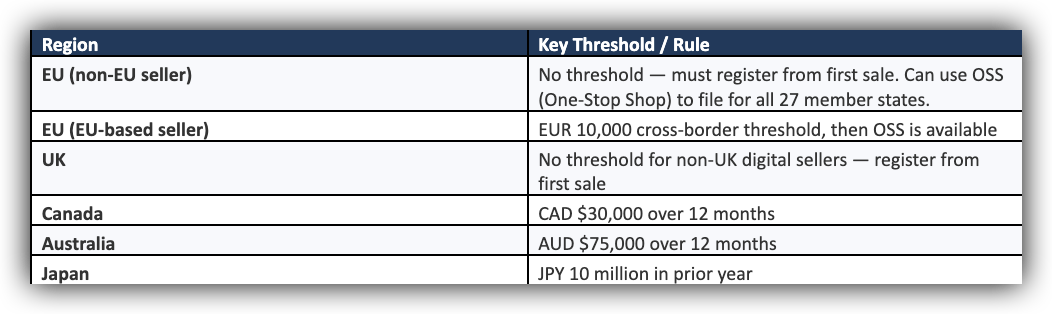
B2B vs. B2C (Reverse Charge)
- In many countries, B2B sales use a reverse charge mechanism — the buyer accounts for the VAT, not the seller.
- VAT collection obligations often only apply to B2C (consumer) sales.
- To qualify for reverse charge, the buyer must provide a valid VAT identification number.
6. Marketplace Facilitator Laws (US)
- In most US states, marketplace facilitators (Amazon, Etsy, Walmart, etc.) are required to collect and remit sales tax on behalf of third-party sellers.
If your customer sells only through a marketplace, the marketplace may already handle sales tax for them. - If they sell on their own website AND through marketplaces, they likely need to collect tax on their direct sales themselves.
Watch out: Customers should not double-collect — if the marketplace is collecting, you should not also charge tax on those orders.
7. Helpful Resources
- Avalara — Tax compliance platform
- TaxJar — Sales tax automation & filing
- Streamlined Sales Tax (SST) — Multi-state registration (sstregister.org)
- EU One-Stop Shop (OSS) — EU VAT simplification scheme
- State Dept. of Revenue websites — For individual state registration and filing
- A qualified CPA or tax advisor — Always the best recommendation for specific situations
Frequently Asked Questions
Q: Do I need to collect sales tax?
A: If you have nexus in a state — either physical presence or you’ve passed the economic nexus threshold (usually $100K / 200 transactions) — you’re generally required to. We recommend confirming with a tax professional.
Q: What rate do I charge?
A: Rates vary by state, county, and city, and depend on what you’re selling. Tax automation tools or a CPA can help you apply the right rates.
Q: Do I need to charge VAT for international sales?
A: Many countries require digital sellers to collect VAT on sales to consumers. The rules and thresholds vary by country. We’d recommend looking into VAT compliance or talking to an international tax advisor.
Q: I’ve been collecting tax but haven’t filed.
A: We’d strongly recommend reaching out to a tax professional ASAP. Collected sales tax needs to be filed and remitted — there can be penalties for late filing. A CPA or tax service can help you get caught up.
Q: Can your platform handle tax for me?
A: SamCart has built-in Sales Tax & VAT calculation available on all current plans, automatically calculating sales tax for the US, Canada, Australia, UK, EU members, and dozens more countries. You will have to remit with a tax specialist.
Q: What about tax-exempt buyers?
A: Some buyers (nonprofits, resellers, government) may be exempt. They need to provide a valid exemption certificate. You should collect and store these — the burden of proof is on the seller.